
Blogging Towards Sunday, October 26, 2025
Today we finish up a series on sin. We’ve looked at how sin is the opposite of what God wants for us. God created us to be alive and thriving in the image of God – co-creators, in community, entering into the perichoretic dance of the Trinity…the goal and telos of creation: deep, mutual, life-giving communion.
And yet….
Along the way we choose sin, we want more than to be in the image of God we want to be God’s equal. From our fear and anxiety, we often mistrust God. We mistrust each other. We even mistrust ourselves. Sin is both pride and self-doubt. It’s both taking all the place to dominate others, and taking up no space allowing others to dominate and negate us. We’ve even seen through the theological work of Reinhold Niebuhr how sin insinuates itself into all human action, including not only what is widely commended as evil but also what is commonly praised as good.
It’s maybe clearer now than ever, in particular to those of us who’ve been privileged enough to not suffer on a regular basis, that things are broken in our country and world. We’re seeing in our world, our nation – even our city – the reality that Paul speaks of in Romans 8. The world is broken, fallen, corrupted by futility, fear, mistrust, sin. It’s not just in people, but in our systems and organizations. That’s what most -isms are. Racism comes from the lie that some people are inherently better, more worthy, more “in the image of God” than other people – and that we can tell that by our skin color. Classicism – where it’s the same lie of superiority and inferiority based upon class, background, education and wealth. What makes us worthy of God’s love – is God’s radical, transformative, inclusive love that we know in the person, purpose, resurrection, and story of Jesus the Christ.
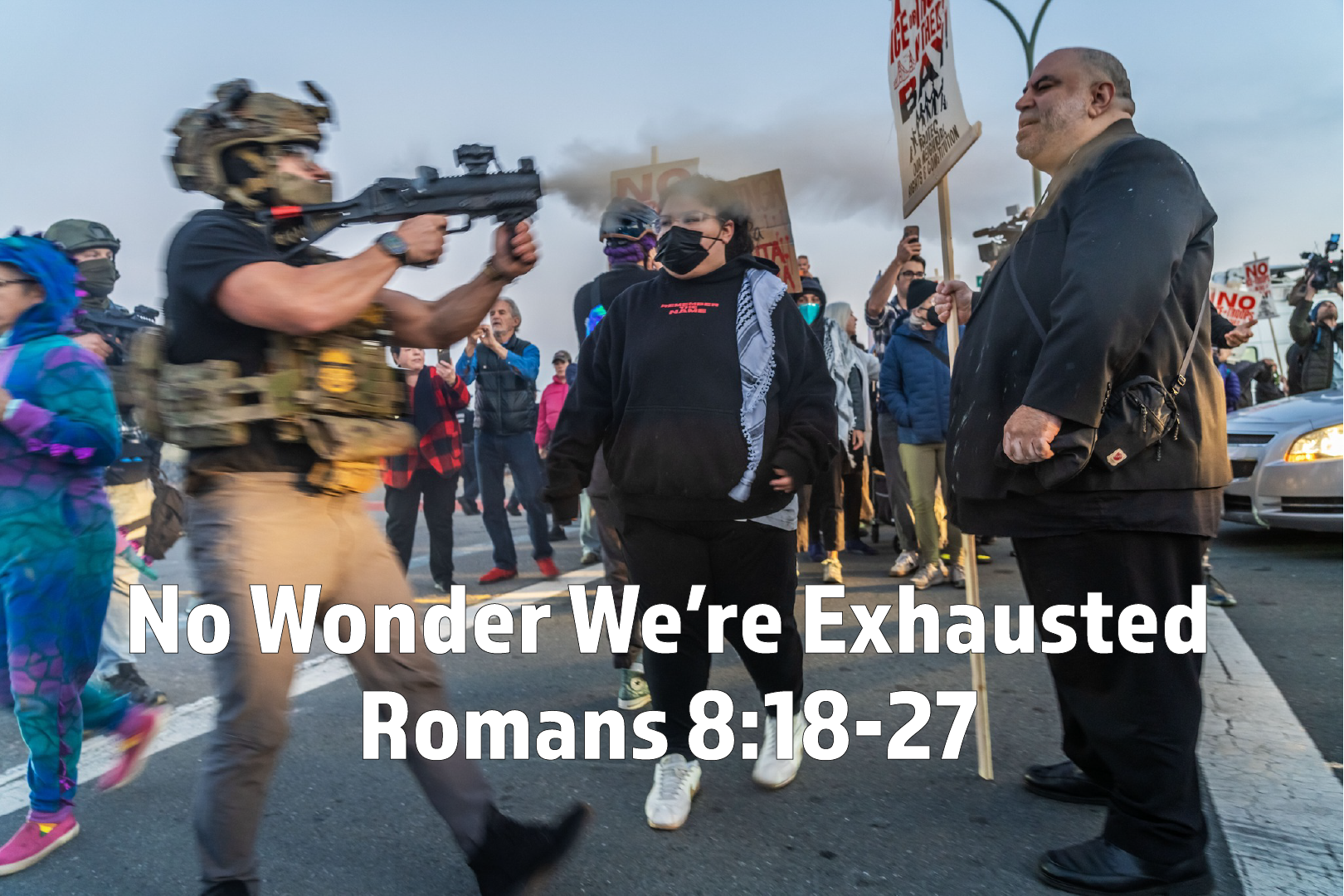
Our government sent troops into our local Bay Area this week. It was a vivid and vicious reminder of the way in which we as human beings – and the systems we live in – are corrupted by sin. Our own government, in a land that claims to be one in which all are equal, demonstrates the corrupting and corruptive power of sin. The Supreme Court recently ruled in Vasquez Perdomo v. Noem, that government officials can stop and detain people merely because of their race, language or appearance. Maybe that’s what we saw in the government agents shooting Rev. Jorge Bautista (a Spanish-speaking, brown pastor of our Presbytery) in the face with a smoke grenade this week at a peaceful protest when he was invoking scripture against the work of ICE.
QUESTIONS FOR REFLECTION & EXAMEN:
• What engaged, enraged, or surprised you in these texts?
• Paul speaks of sin as futility, aimlessness, decay and corruption. He implies that creation (the world) is influenced, shaped, by the sin of humanity. What does that mean? How do you agree or disagree?
• Paul uses the image of childbirth for the salvation of the universe, or the universe being made whole (healed). How does this birthing process image speak to you about your experience of the work of God in Jesus in and on the world?
• How have you experienced sin as more than the choice of an individual, but also a system or contagious force that takes over institutions, world views, identities, or even the work of the church?
• What hope do you hear in this passage (the shorter and longer one – all of Romans 8)?
• What do you hear God saying to you through today’s read-ings?
 CAPC Oakland