
Blogging Towards Sunday, September 14, 2025
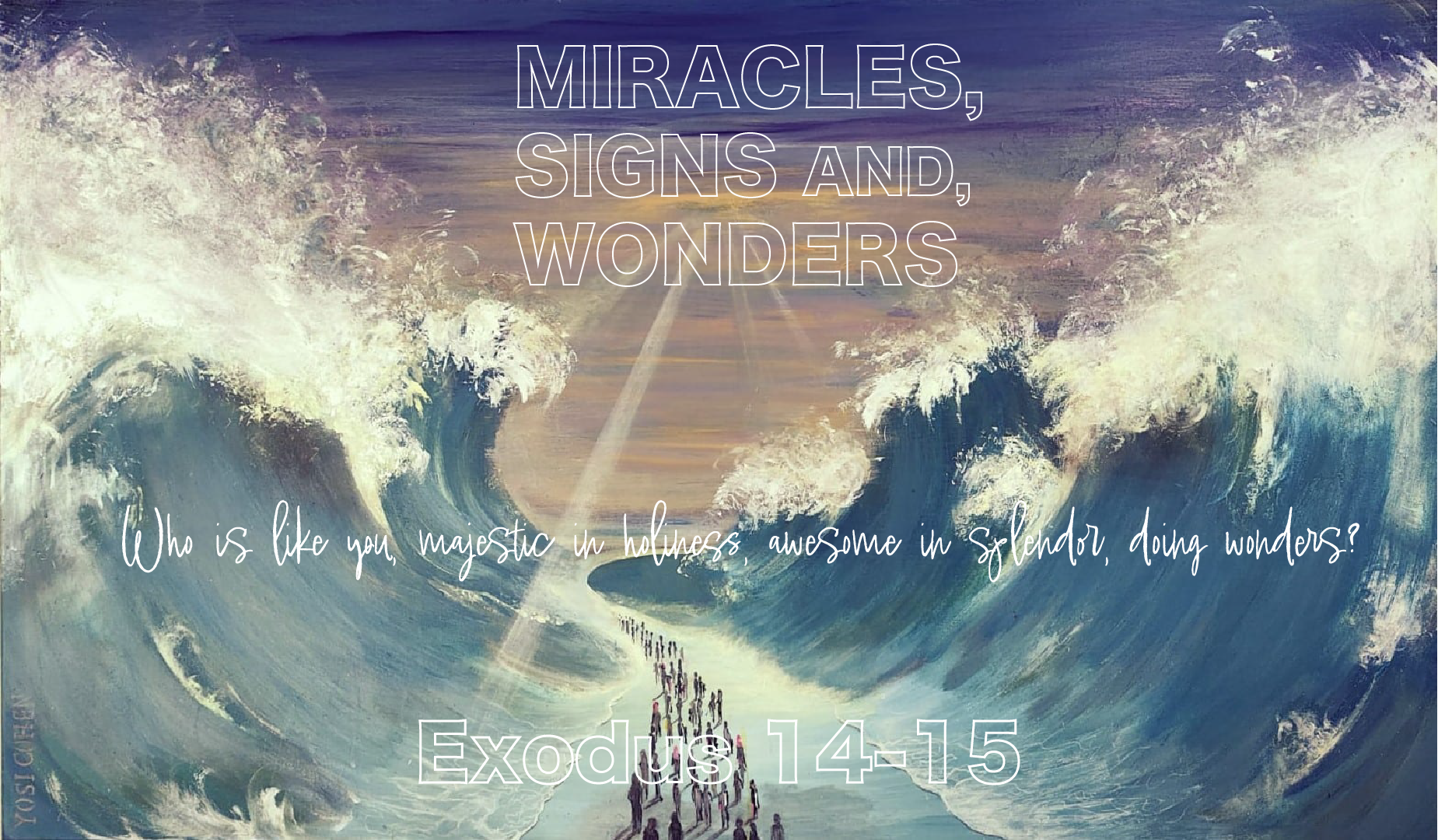
We’re continuing a month-long series on Miracles, Signs and Wonders. A common expression of awe is “It’s a miracle!” Together, we’re wrestling with what do we mean when we say it?; and what’s it mean in the Bible.
We’ve already see that with all literature and communication it’s good for us to start by taking a closer look at the words we use to talk about something bigger than the words. In Koine Greek, the language of the New Testament, the word for “miracle” is not a single, direct equivalent like the English word. Instead, several terms are used, each highlighting a different aspect of the miraculous event. The most common are σημεῖον (sēmeion), meaning “sign,” δύναμις (dunamis), meaning “power” or “mighty work,” and τέρας (teras), meaning “wonder.”
Today we’re looking at the core story of the Exodus – God making a way where there was no way, freeing the enslaved Israelites from the oppressive hand of Pharaoh in Egypt. In that story there are repeated “miracles” – culminating in the Exodus – most of which are called “marvels” and “wonders” from the Hebrew word פֶלֶא (pele) 15:11 which refers to something beyond human ability: a divine act.
“All the critical verbs in the core story in Exodus 13:17-14:31 are powered by God. The people cry out and complain. And Moses obeys a few orders. But God, and God alone, does the work of salvation. Twelve God-activated verbs carry the action of the story, with saved as the summarizing verb.
The Hebrew language has a rich vocabulary to tell what God has done to help his people, but the word we translate as “salvation” or “save” is by far the richest in connotations and the most common. In the reading of this Exodus salvation story, we come upon it first before the people’s deliverance – ‘Stand firm and watch God do his work of salvation for your today’(14:13) – and then again at the end, after God has rescued them – ‘So the LORD saved Israel that day’ (verse 30). ‘Salvation’ and ‘save’ frame the story.
The wonder at the Red Sea establishes the fact that salvation consists in which God does, not in what we do. We ‘realize [God’s] tremendous power,’ stand ‘in reverent awe before’ him, and trust in him (verse 31), and that’s it. When was the last time you heard a religious or political leader say, ‘You only have to stand and watch God o his work of salvation?’
But that’s what we’re told here. And that what we need to be told whenever we find ourselves facing an advancing enemy with our backs against some impassable sea.”
Eugene Peterson, comment in the Message Translation in Exodus 14-15.
QUESTIONS FOR REFLECTION & EXAMEN:
• What engaged, enraged, or surprised you in these texts?
• You’ve most likely heard this story before. What do you hear for the first time, or that you’ve not noticed before as you read it today?
• The story focuses upon the agency, or action of God. What does God do in the story? Moses? The Israelites? Pharaoh? Who is it that saves the Israelites?
• Why do the Israelites complain – verses 11-14?
• What is the miracle, or what are the miracles in this story?
• When have you experienced God making a way where there was seemingly no way?
• What do you hear God saying to you through today’s readings?
 CAPC Oakland