
Blogging Towards Sunday, August 31, 2025
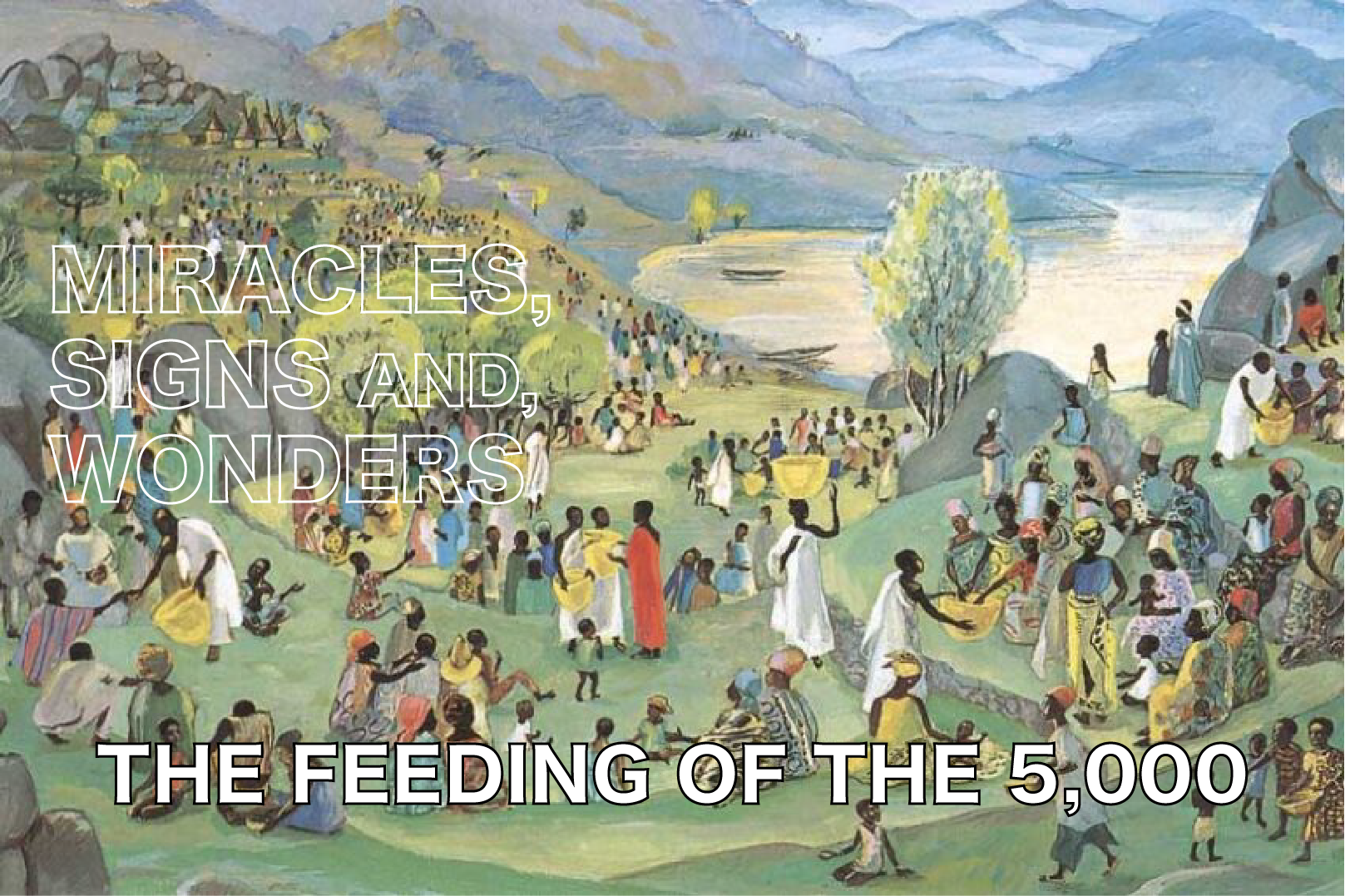
Miracles, Signs & Wonders: The Feeding of the 5,000 | Matthew 14:1-27
We’re starting a new month-long series on Miracles, Signs and Wonders. A common expression of awe is “It’s a miracle!” What do you mean when you say it?
We have different perspectives on miracles– the impossible coming to pass. For some miracles are proof of God’s existence, love and or involvement. Others might explain them as lucky moments of chance. Still others explain them scientifically or sociologically. And for some, miracles are just not possible in our materialist world shaped by cause and effect and organized by the scientific laws that we continue to discover. Whether experienced as proof against doubt, or a stumbling block for faith, it’s worth while in our spiritual journey and communal life for us to take a closer look together at miracles, signs and wonders. (This expression comes form Hebrews 2:4)
As with all literature and communication it’s good for us to start by taking a closer look at the words we use to talk about something bigger than the words. In Koine Greek, the language of the New Testament, the word for “miracle” is not a single, direct equivalent like the English word. Instead, several terms are used, each highlighting a different aspect of the miraculous event. The most common are σημεῖον (sēmeion), meaning “sign,” δύναμις (dunamis), meaning “power” or “mighty work,” and τέρας (teras), meaning “wonder.”
How do we understand miracles –
• Things that can’t be explained except by saying God did it.
• Things that are impossible, not scientifically explainable
• Things that defy (our) human logic
• Things that defy our world view
• Things that no person could simply make happen
• Things that are beyond what could ever be expected or imagined
• Things that are too beautiful to be a coincidence.
While “miracle” is often used as a general translation for these terms, understanding the nuances of each Greek word provides a richer understanding of the different perspectives on miracles in the New Testament.
Today we’re wrestling with the miracle and wonder of Jesus feeding the 5,000 from a fives loaves of bread and two fish is the one we’re considering today. Can you guess which of the 4 Greek words we translate as miracle is used by Matthew in the text?
Questions for Reflection & Examen:
• What engaged, enraged, or surprised you in these texts?
• How do you react to the word miracle and the notion behind it?
• What miracles have you experienced?
• What is the miracle in the story of the feeding of the 5,000?
• Does the story change when you consider the larger context of its telling, including verses 1-12 and 22-27?
• How is the story of the disciples faced by the persecution of King Herod our story as the church?
• How is the story of the hunger of the 5,000 being fed by the strength of Jesus our story as the church in the desert where we can only rely on our own resources which are few amidst of world of deep cravings, loneliness, disorientation and poverty?
• How is the story of the disciples in a boat on the unpredictable sea our story as the church threatened by the power of chaos, destruction, fear and opposition?
• What do you hear God saying to you through today’s readings?
 CAPC Oakland