
Blogging Towards Sunday, August 17, 2025
“Meadowlark Sings and I Greet Him In Return” and “Storage” and Matthew 6:25-34
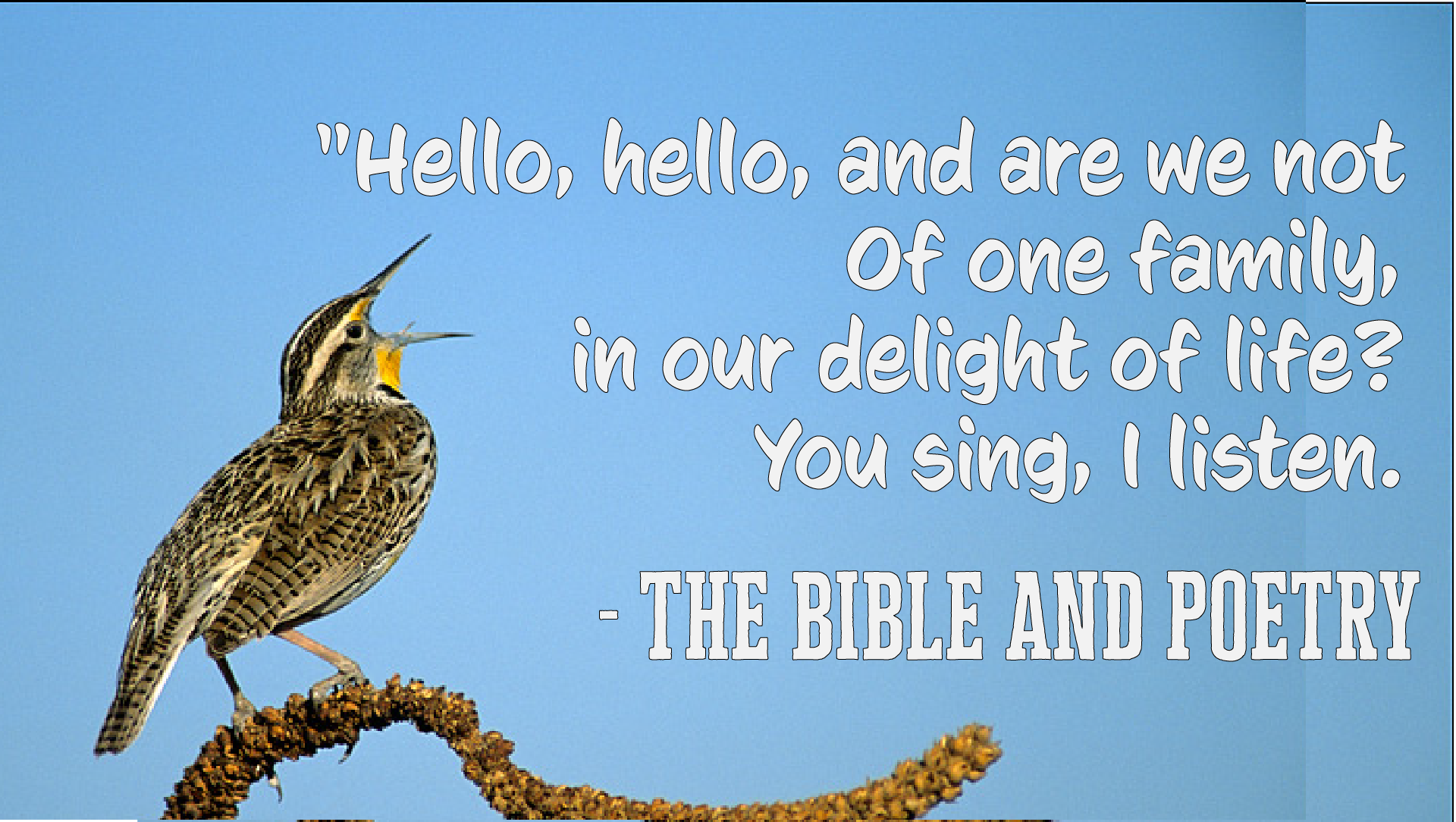
The Bible and Poetry
To believe in the Bible—or, rather, to believe the Bible, and to allow oneself to be convinced that it is the word of God, in whatever way one considers it—is to believe what it says, with a supernatural faith that resembles, at an infinite distance, the confidence with which we read a poem, accepting that its reality is found in it and not in our exegeses. This allows for adhering to the truth that is at once included in the words and liberated by them, whatever the difficulty posed by the Flood, for example, or the Tower of Babel. We do not necessarily know the exact nature of the truth that is revealed to us, but we know where to look for it, just as we do not necessarily understand a poem but we look for the answer to our questions in the poem itself, without adding or subtracting anything.
Poetry attracts our attention to language and to the mystery of words, to their capacity to create, almost by themselves, networks of meaning, unexpected emotions, rhythms and a music for the ear and for the mouth that spreads through the entire body and all one’s being. … The poetic act draws close to the real and, in or-der to go to the depth of things, it recreates them for us by welcoming them in sounds, rhythms, and unlim-ited ramifications of meanings, and places these recreations in the domain of the possible. In its own way, and without at all being supernatural, poetry too is a revelation.
The Bible as revelation …does not develop exclusively in poems,.. but its writings often turn into verse, as if it considers poetry to be the speech most appropriate to the strangeness, to the transcendence of what the Bible manifests.
Think of the words of Jesus. He speaks quite often in parables, in order to present complex truths in the form of stories and within the life of a few characters, and in order to provoke his listeners—and us, his readers—to search, each time, for meaning in the multiple facets of a fiction. His affirmations in prose are poetic in that they are not understood right away; they ask that we receive them as we receive poetry, by becoming con-scious of the mystery that accompanies them.
Reading the Bible is a “poetic” experience.
redacted from The Bible and Poetry
By Michael Edwards June 12, 2023 in the Paris Review
https://www.theparisreview.org/blog/2023/06/12/the-bible-and-poetry/
QUESTIONS FOR REFLECTION AND EXAMEN:
• How do these poems make you feel?
• How do you connect with them? How do they connect with your experience, or maybe what you’re living today?
• How do you struggle with reading the Bible?
• How do you experience the Bible as true, or containing truth?
• What do you struggle to accept as part of the way of life, of reality?
• What might the Spirit of God be saying to you, or inviting you to through today’s readings?
 CAPC Oakland